The EU has launched a new digital system to keep track of travellers when they enter Europe. It’s called the Entry Exit System, known as EES for short.
The EES launched on Sunday 12 October, but there was a lot of confusion and questions around how the system would actually work.
So I travelled to Tallinn, Estonia, on EES launch day to see what these checks really mean for passengers travelling to Europe.

What Is the EES?
The Entry/ Exit system, or EES, is a new automated computer system that tracks the movement of travellers into and out of most European countries – specifically countries in the Schengen Area.
The EES is a digital system which captures your biometric data – that’s a face scan and fingerprints – and is set to replace the physical passport stamping that happens right now instead.
As well as your biometrics, the EES also logs your name, the details of the document you’re travelling with and your dates of entry to and exit from the Schengen Area.
What date did EES start?
The official EES launch day was 12 October 2025, but this is just the start of a gradual rollout of six months. This is to allow each country to get on top of the new system and iron out any challenges.
The EU is expecting the EES to be fully operational by 9 April 2026.
When will this come in for my next trip to Europe?
Because the rollout is gradual, it’s hard to say exactly what you’ll experience on your next trip. Countries are being given time to get the system up and running without any hitches, and won’t be running it for all passengers all the time.
Estonia, Czechia and Luxembourg have rolled out the EES across all their border crossings from day one, but lots of countries haven’t started taking biometric data yet.
You can read more about the EES, which countries are operating it and what you can expect if you travel to Europe in the next six months in our article below.
My EES Experience Flying to Tallinn
I flew to Tallinn, Estonia on the day that the EES launched – Sunday 12 October 2025 – to see for myself how this new digital system was working on launch day.
Plus I’d be able to share my experience and help you know what to expect if you’re travelling to Europe soon.

Why did I choose Tallinn?
Estonia, alongside Czechia and Luxembourg, was one of the few countries that decided to roll out the EES across their country from day one, so I thought it would be a good shout.
Also, as a country renowned for their quick uptake of technology (did you know that you can vote in the general election there online?) I thought it would be a good pick.
However, I soon realised that wouldn’t be the case…
London to Tallinn

Check in, security and boarding at London Luton Airport
Everything was exactly the same as what I’m used to when flying from the UK – and this will be the case going forward too.
This is because the EES is an EU initiative and not a UK one, and since it’s set to replace passport stamps it means that it impacts your journey at that point – where you would normally get your passport stamped by border control.
So no need to turn up to the airport early this side, just make your way to your gate and board your plane as normal.
Landing in Tallinn
I was interested to hear whether there would be any information given on the plane, like they sometimes do when you need to fill in visa information.
However, the EES was not mentioned at all and landing at Tallinn Airport was so far exactly what I had experienced in the past.
But, that was about to change…

Border Control at Tallinn Airport
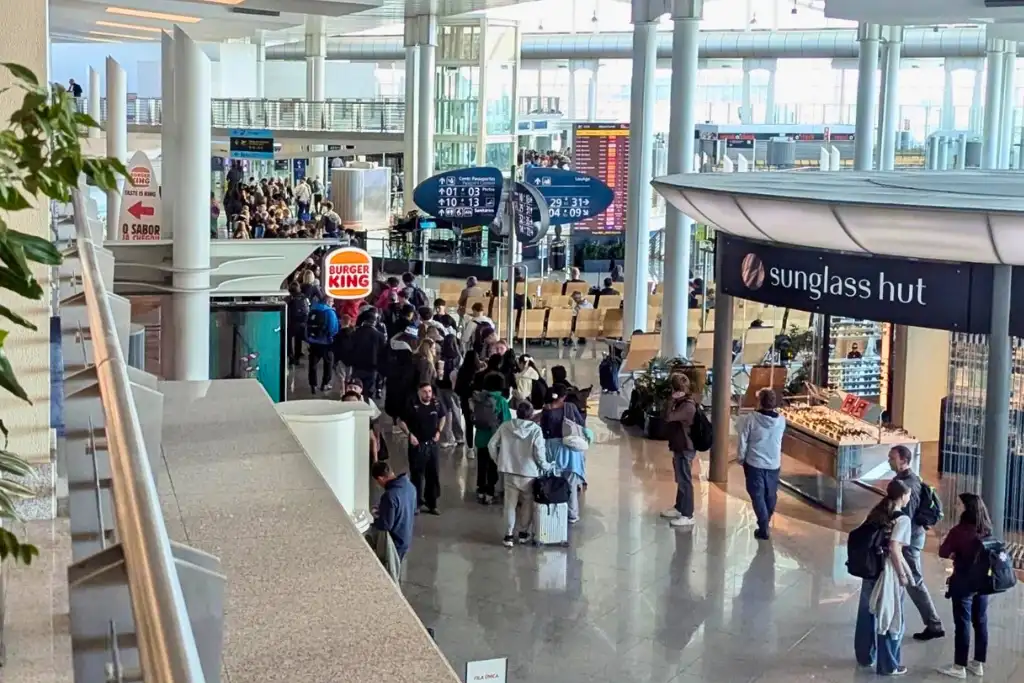
Given that the Estonians are pretty tech savvy, I walked up to border control expecting to see a barrier of EES kiosks ready to take our details. However, I only saw the EU e-gates to the left and the border control desks to the right. Basically, it’s exactly the same set up as before the EES.
Since I was one of the first people off the plane, there wasn’t any queue and so I joined the queue and watched a woman go through her checks, wondering if perhaps they hadn’t started doing EES checks after all.
However, I quickly realised that they were because there was a lot of questions and confusion going on, and the woman wasn’t able to make her through to baggage for another 4 minutes.
Then it was my turn.
The EES Process for arriving in Tallinn Airport
I started my timer as I stepped forward and presented my passport.
Face scan
The border agent scanned my passport, and then asked me to turn to get my photo taken. This part of the process is also known as a face scan. The camera was built into the side of the border control booth and took my photo.
To the side of me, I could hear a gent having issues as he had taken his photo with glasses on, but they had to be taken off.
Fingerprints
Next, I was asked to give my fingerprints and I presented my right hand and pressed my 4 digits in. This took a few seconds to process, but then I was done. They did not ask for my thumb print.
Questions about my trip
Then, I was asked the purpose of my trip – ‘I’m here to visit a spa’ – and how long I’d be staying – ‘one night’.

Overall process
Now, this all seems quite straightforward written down but the overall process was quite slow.
The agent was looking apprehensive about the process and asking his colleague for next steps. I expect this is because it was day one and they too are getting used to the change.
This was heightened by him realising that my photo had not been taken properly, and I had to do it again.
Passport stamp
The final step was getting a passport stamp which by April 2026 will stop happening, but during this six month rollout you will get EES checked and get a stamp.
Time check
By the time I got my passport back I had been at the desk for 3 minutes at 57 seconds.
Behind me, quite a large queue had formed with around 8-10 people in the 4 queues in operation. Bearing in mind that processing for me and the woman in front of me had taken around 4 minutes each, that could mean a wait of 40 minutes for some.
This hit even harder when you witnessed those with an EU passport whizzing through the E-Gates!
But overall, I was through and hoping that now I was registered – and would be for 3 years – that my next check would be a lot quicker.
Watch the video of my experience
I filmed my journey to Tallinn to show you how my experience went on EES launch day. See how I got on over on Instagram and TikTok!
I also filmed the way back to show you what to expect when you leave a Schengen Area country to fly back to the UK. Watch on Instagram below or head over to TikTok.
Tallinn to London
After my 24 hours in Tallinn (yes I really did come to visit a spa!) it was time to return home and see what EES checks awaiting me before my flight to the UK.

Check in and security at Tallinn Airport
As expected, absolutely zero changes to the check in and security process at Tallinn Airport. These checks really do only impact the process at border control.
My flight was actually 3 hours delayed and so I arrived at the airport for 8pm when there weren’t many flights left to take off. So everything was very quiet!
Tallinn Airport
Once through security and past the already closed Duty Free, I was in the area of the airport that has shops, cafes and bars. It also has boarding gates but these are all to other European countries in the Schengen Area – that’s the area where they share border rules so you can fly between them without a border check.
However, I am flying back to the UK which is not in the Schengen Area (and has never been!) and this is why our gates are always behind border control where in the past you get your passport stamped before you fly home.
But what will happen this time?
Tallinn Airport Border Control
Similar to my arrival, there are no EES self service kiosks in this area – or at other points in the airport.
I actually did ask at the airport info desk about this. They said they do have them, but they aren’t up and running yet. However, they were not in sight anywhere and I know that in other airports, even when they’re not being used they are in place. So I do wonder what their plan is at this airport. Perhaps they’re working on a new area where these machines will all be?
The EES Process for leaving Tallinn Airport
There was no queue, though this is likely as my flight was so delayed that many people had already made their way through.
Face scan
I handed over my passport which they scanned, and was first asked to do a face scan. This didn’t work twice, but did on the third time.
This feels like something that isn’t quite seamless yet, and unfortunately does add a decent amount of time onto the process which will really add up when you multiply it by how many people need to do it.
Fingerprints
Next, I was asked to give my fingerprints. I was surprised by this since after you first register, it’s been suggested that you may only have to give a face scan or fingerprints – not both.
Questions about my trip
I wasn’t asked any questions, though this is likely because I was leaving and therefore there was no need to ask the purpose of my trip, where I am staying, how much money I have and how long I plan to stay.
Passport stamp
Finally, I got my passport stamped and I made my way through.
Time check
This whole process took just under 2 minutes.
Landing in London Luton
I landed in London Luton and went through UK passport control as standard. The EES has absolutely no impact on this process – the UK border agents can’t access that information you have registered!
My final thoughts
I’m gutted that Tallinn didn’t have any self service kiosks in place but it was good to experience what a manual EES check was like. Especially as many people will have to go through manual checks if their destination doesn’t have kiosks, the kiosks aren’t working or if they have requirements that mean they’re best doing their checks with a person.
My main takeaway is that whilst my checks didn’t have a big impact on my trip, I can really see how they could. Tallinn is a less popular destination, but we’ve already seen from huge queues at Prague airport just how wait times can spiral beyond an hour when several flights come in at once.
Plan your time at the airport
This could affect plans you have on arrival, such as what time to book a transfer or pick up a hire car, or even catch a connection if you’re continuing to another EU country.
The way back home poses more questions too, since it becomes harder to know what time to get to the airport to make sure you get through border control in time.
As someone who loves to be as efficient as possible at the airport, I can see the days of arriving just over an hour before a flight being long gone. In fact, my advice at the moment is to check your airport’s social media and website to see what times they are suggesting if they do have the EES in place.
Journey times with the EES will be longer
Of course, we are just in the first week and so hopefully things will get slicker as airports understand and work out the kinks that are slowing them down. I really hope that the airports who have not started the EES yet – which is most of them – can use these learns so it is smoother when they start.
But overall, I think we have to accept that this process is going to slow us all down. Even when passport stamps are phased out in six months time, we will still need to visit a self service kiosk or have some scans and questions asked at the desk every single time we travel. Which I guess is one of the harsh realities of voting to leave the EU and the perks that that union afforded us with travel to and from Europe.